


Manual order entry costs foodservice suppliers far more than the typing. Re-keying orders from email, SMS, WhatsApp and handwritten notes creates wrong pack sizes, incorrect quantities, missed notes and pricing mistakes, consumes admin labour, slows the warehouse, buries orders across channels and makes growth depend on adding admin hours.
Key takeaways
- The cost is the mistakes, clarifications, invoice corrections and missed messages, not the typing
- Small repeated tasks across hundreds of weekly orders create unmeasured admin labour
- Every manual handoff risks wrong pack sizes, quantities, notes, delivery instructions or pricing
- Orders spread across channels get buried, which customers experience as unreliability
- Manual workflows scale by adding pressure to admin staff rather than by better systems
- Digital portals, message-to-order capture and one dashboard replace repeated re-entry
In this guide 3 sections

Many foodservice suppliers still rely on staff to manually enter orders from emails, text messages, WhatsApp chats, and handwritten notes. At first, it can seem manageable. But as order volumes grow, manual order entry becomes one of the most expensive hidden inefficiencies in the business.
The cost is not just the time it takes to type in an order. It is the mistakes, delays, clarifications, invoice corrections, missed messages, and daily operational friction that quietly build up over time.
Manual Order Entry Seems Manageable Until You Look Closely
Most suppliers underestimate the cost because the work happens in small, repeated tasks throughout the day. Someone reads a message, interprets what the customer meant, searches for the right product, checks pricing, enters the order, then fixes it later when something changes.
None of these tasks feel major on their own. But across hundreds of orders each week, they create a significant amount of admin labour that often goes unmeasured.
Over time, this becomes more than an inconvenience. It becomes a drag on efficiency, margin, and service consistency.
Related guideWholesale Order Management for Foodservice SuppliersThe Hidden Costs Show Up Everywhere

Accuracy
Every manual handoff creates another opportunity for error. Common problems include:
- wrong pack sizes
- incorrect quantities
- missed notes
- outdated delivery instructions
- pricing mistakes
Even a small mistake can affect warehouse picking, deliveries, invoicing, and customer trust.
Labour
Even when staff are fast, manual order entry still consumes time that could be spent on more valuable work. As order volumes rise, many suppliers find themselves adding admin hours just to keep up.
Speed
Warehouse teams can only pick as well as the information they receive. If orders are inconsistent, incomplete, or unclear, delays and mistakes flow through the rest of the operation.
Missed Orders and Customer Frustration Add Up Fast
When orders come in across multiple channels, it becomes easy for messages to be buried or overlooked. A late-night text, a photo sent through WhatsApp, or a change hidden in an email thread can all be missed.
From the supplier side, it may feel like a small admin slip. From the customer side, it feels unreliable.
That is where manual order entry becomes more than just an internal process issue. It starts affecting customer experience and retention.
Manual Order Entry Also Makes Scaling Harder
Manual workflows may survive at a small scale, but they become a bottleneck as the business grows. Every new customer brings more messages, more follow-ups, and more exceptions to manage.
Instead of scaling through better systems, the business scales by adding more pressure to admin staff. That model is expensive, inconsistent, and hard to sustain.

Why Suppliers Are Moving to Automated Order Capture
More suppliers are now replacing manual order entry with a combination of digital and automated tools.
This typically includes:
- Digital Ordering Portals - Customers place orders directly using accurate products, pack sizes, and pricing.
- Smart Order Capture From Messages - Orders sent by email, SMS, or WhatsApp can be converted into structured digital orders.
- Centralised Order Dashboards - All incoming orders are managed in one place instead of across inboxes and message threads.
- Automated Picking Workflows - Warehouse teams receive clean pick lists immediately.
- Integrated Delivery and Invoicing - Orders move through to delivery, proof of delivery, and invoicing without duplicate data entry.
This approach reduces admin time, improves accuracy, and gives suppliers a more scalable operation.
Related guideHow Wholesale Food Suppliers Can Eliminate Manual Orders ForeverThe Benefits Suppliers Notice Quickly
Suppliers who move away from manual order entry often see immediate gains, including:
- Fewer order errors
- Less admin work
- Faster warehouse picking
- Reduced overtime
- Fewer customer disputes
- Faster invoicing
- Better reporting
- Lower cost to serve
- Stronger customer retention
In many cases, the improvement is noticeable within days.
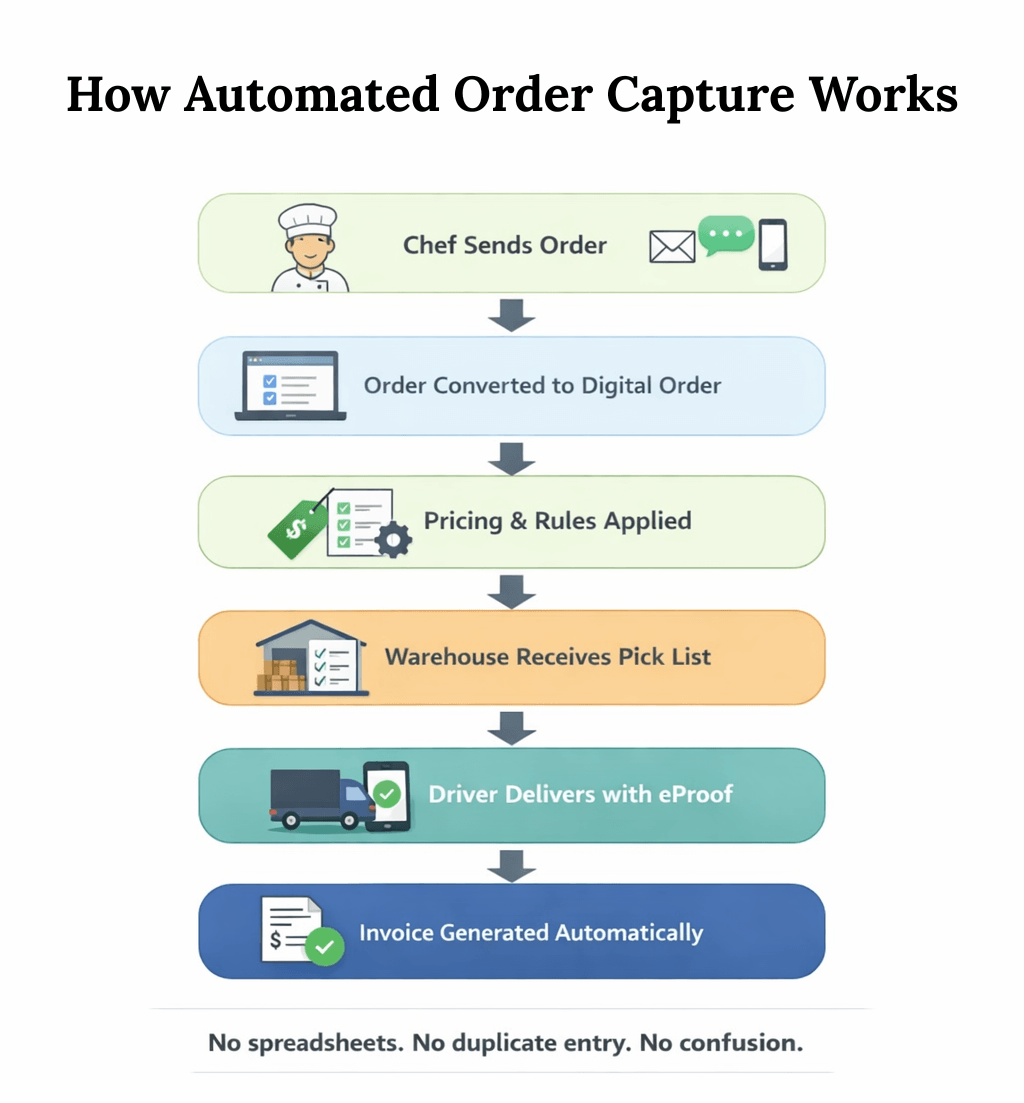
Open Pantry helps foodservice suppliers move away from manual order entry by bringing order capture, pricing, inventory, and fulfilment into one platform. Suppliers can give customers a branded online ordering portal, while also using Open Pantry’s AI-powered tools to convert email and SMS orders into structured digital orders. That means less retyping, fewer mistakes, cleaner pick information, smoother delivery handoff, and faster invoicing from the same order record. For suppliers trying to reduce admin and scale more efficiently, Open Pantry creates a much simpler path from order to delivery.
Manual order entry is one of those problems that rarely feels urgent in the moment, but becomes expensive over time. The businesses that grow efficiently are usually the ones that reduce repetitive admin, improve order accuracy, and create a cleaner path from order capture through to fulfilment and invoicing.
Cut manual order entry and streamline your supply workflow with Open Pantry.
Explore the supplier platform today!
Frequently asked questions
What does manual order entry really cost a foodservice supplier?
Far more than the time spent typing. The cost sits in mistakes, delays, clarifications, invoice corrections, missed messages and daily operational friction. Someone reads a message, interprets what the customer meant, finds the right product, checks pricing, enters the order and fixes it later when something changes. None feels major alone, but across hundreds of weekly orders it becomes significant.
What kinds of errors does manual order entry create?
Every manual handoff adds a chance of error. Common problems include wrong pack sizes, incorrect quantities, missed notes, outdated delivery instructions and pricing mistakes. Even a small mistake flows through warehouse picking, deliveries, invoicing and customer trust, because warehouse teams can only pick as well as the information they are given.
Why do orders get missed when customers use different channels?
When orders arrive by phone, email, SMS and WhatsApp at once, messages get buried. A late-night text, a photo sent through WhatsApp or a change hidden in an email thread can all be overlooked. From the supplier side it feels like a small admin slip; from the customer side it feels unreliable, and that starts affecting retention.
How does manual order entry limit growth for a foodservice supplier?
Manual workflows survive at small scale but become a bottleneck as the business grows. Each new customer brings more messages, more follow-ups and more exceptions to manage, so the business scales by adding pressure to admin staff rather than by improving systems. That model is expensive, inconsistent and hard to sustain as volumes rise.
What replaces manual order entry for foodservice suppliers?
A combination of digital ordering portals where customers select accurate products, pack sizes and pricing; smart capture that converts email, SMS and WhatsApp orders into structured digital orders; a central dashboard instead of scattered inboxes; automated picking workflows that produce clean pick lists; and integrated delivery and invoicing so data is not entered twice.
How quickly do suppliers see benefits from automating order capture?
Often within days. Suppliers moving away from manual order entry commonly report fewer order errors, less admin work, faster warehouse picking, reduced overtime, fewer customer disputes, faster invoicing, better reporting, a lower cost to serve and stronger customer retention. The gains come from removing repeated re-entry between order capture, fulfilment and invoicing.


