


How Centralised Orders Improve Warehouse Efficiency Fast

Efficient warehouse operations start with accurate and timely order management. For wholesale food suppliers, fulfilment is the real pressure point: early mornings, tight delivery schedules, perishable products, and customers who expect precise, on-time deliveries. When orders arrive from multiple channels and inconsistent formats, warehouse efficiency suffers. Picking becomes chaotic, mistakes multiply, and operations slow down.
Centralising orders into a single digital platform is one of the fastest ways to improve warehouse efficiency — often within days of implementation.
This article explores why fragmented order intake creates downstream problems and how modern order management systems help suppliers achieve faster, more accurate, and reliable warehouse operations.
The Problem: Fragmented Order Intake
Many food suppliers still receive orders from a combination of channels: emails, phone calls, text messages, WhatsApp, PDFs, spreadsheets, online portals, and even handwritten notes.
When orders come from different sources, at different times, and in varying formats, warehouse teams must work harder, increasing the risk of:
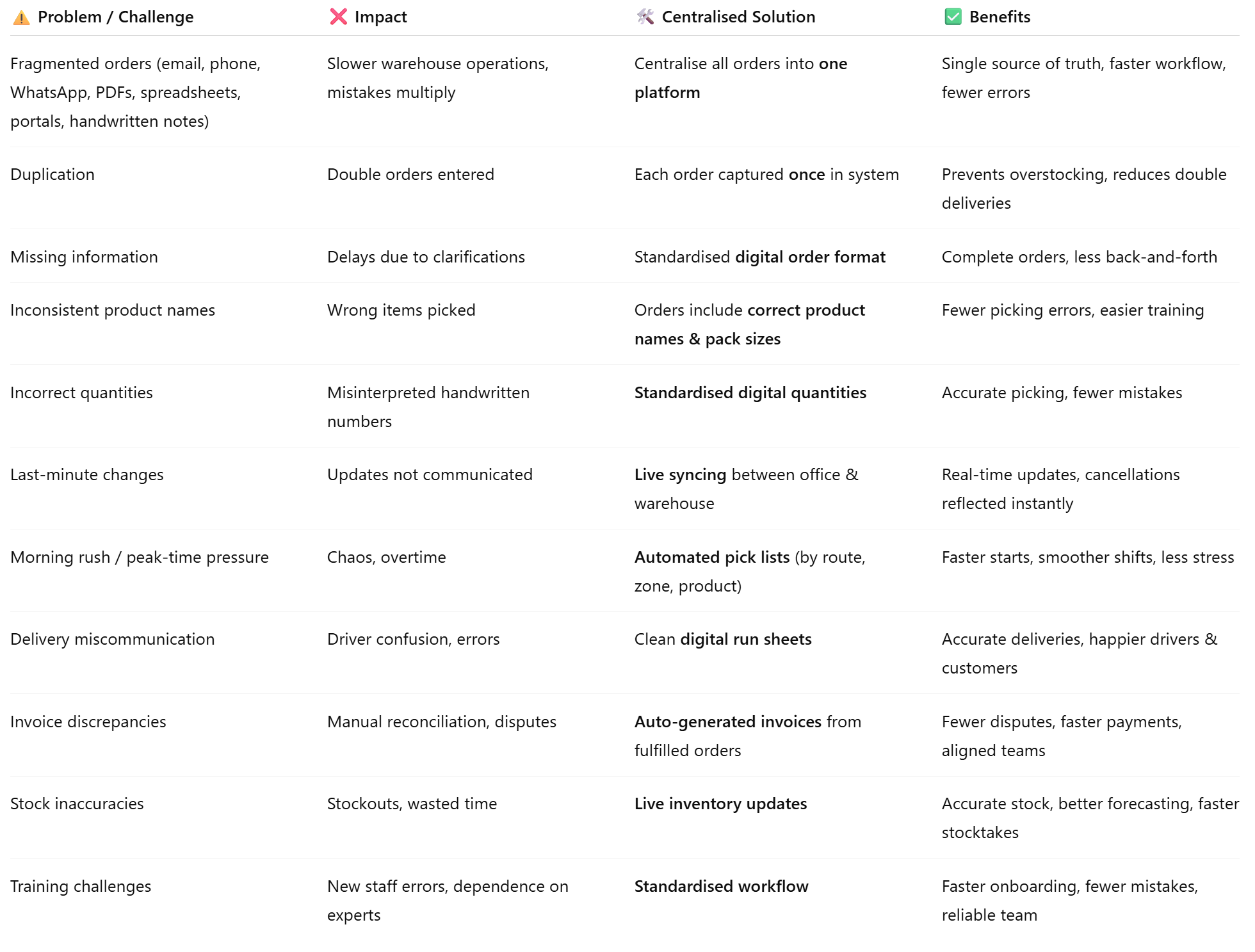
- Duplicate orders – an email and text can be entered twice.
- Missing information – incomplete orders cause delays due to clarification.
- Inconsistent product names – nicknames or vague descriptions create confusion.
- Incorrect quantities – handwritten notes may be misinterpreted.
- Last-minute changes not communicated – updates often fail to reach the warehouse.
Even experienced warehouse teams struggle when the order intake process isn’t standardised.
The Role of Inventory Management in Wholesale Food Distribution
How Centralising Orders Solves Warehouse Challenges
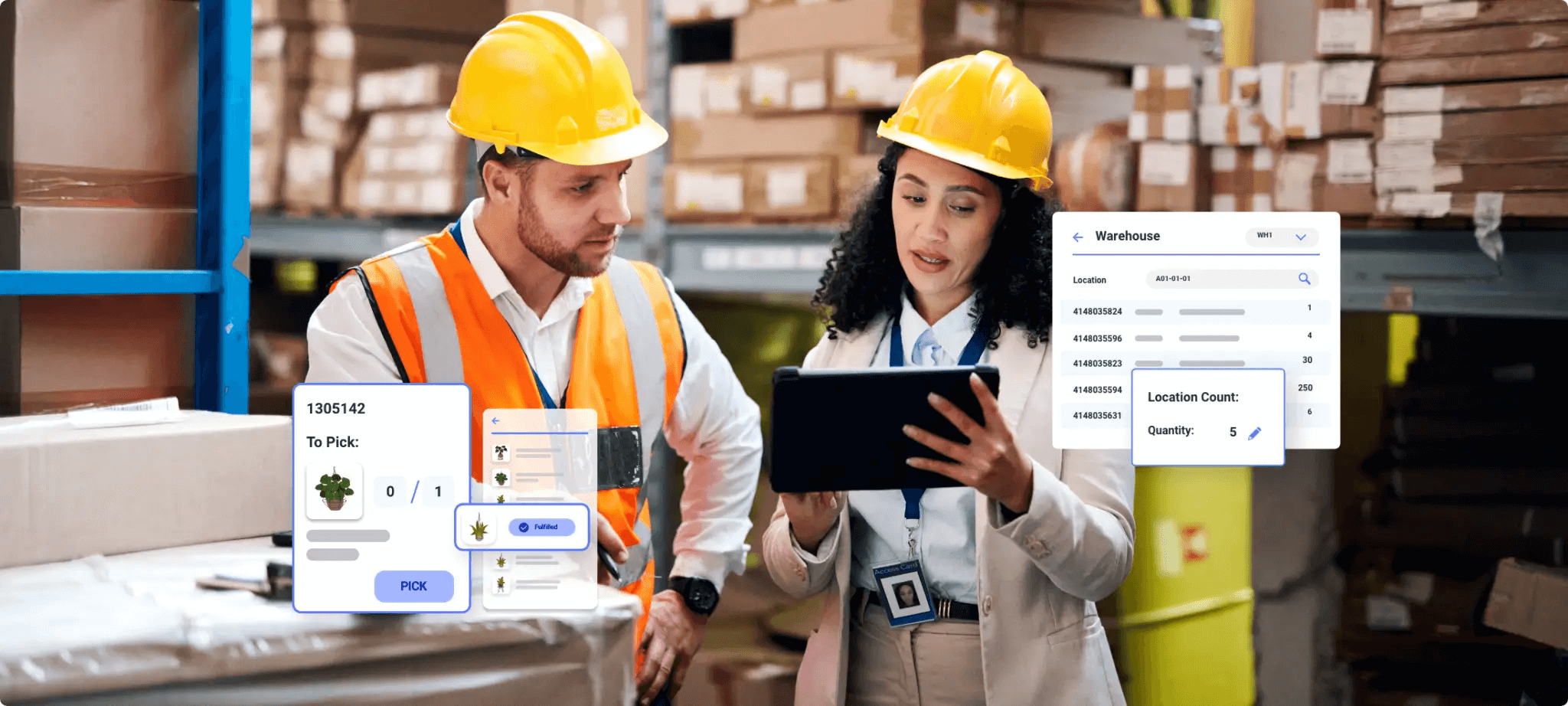
Centralised ordering gives suppliers one reliable source of truth. Platforms like Open Pantry consolidate all orders — digital, manual, email, or phone — into a single interface, improving operational clarity and efficiency.
1. Standardised Order Formatting
A centralised system ensures every order includes correct product names, pack sizes, quantities, delivery dates, special instructions, customer notes, and pricing. Warehouse staff no longer interpret messy notes, reducing errors and simplifying training.
2. Real-Time Syncing Between Office and Warehouse
Live updates ensure warehouse teams see new orders, last-minute changes, cancellations, and updated quantities instantly. This prevents picking errors, reduces wasted effort, and keeps operations aligned.
3. Automated Pick Lists
Centralised order management generates pick lists automatically, organised by delivery run, warehouse zone, customer, or product type. Digital pick lists replace paper slips, guide staff efficiently, and significantly reduce mispicks.
4. Reduced Peak-Time Pressure
Centralising orders smooths the morning rush. Staff start with organised, structured workflows, reducing chaos, overtime, and weekend work, while improving overall warehouse productivity.
5. Improved Communication With Drivers
Accurate run sheets, correct packing, real-time updates, and clear delivery instructions ensure drivers spend less time double-checking orders and more time delivering accurately.
6. Accurate Fulfilment and Invoicing
When warehouses pick from centralised orders, invoices match deliveries automatically. This reduces disputes, accelerates payments, builds customer trust, and minimizes administrative overhead.
7. Better Stock Management
A centralised system tracks inventory in real-time, enabling accurate stock levels, better forecasting, fewer stockouts, faster stocktakes, and smarter substitutions. Warehouse teams avoid searching for non-existent items or guessing replacements.
8. Easier Staff Training
With standardised workflows, new staff learn faster, make fewer mistakes, and operations are less reliant on specific “expert” employees. Training time decreases while operational reliability improves.
Best Inventory Management Systems for Wholesale Food Suppliers
Modern Warehouse Workflow With Centralised Orders
Centralised order management creates a predictable, friction-free workflow:
- All orders enter one system, digital or manually converted.
- Warehouse sees live updates instantly.
- Pick lists are generated automatically.
- Pickers record shortages or substitutions digitally.
- Orders move into delivery runs.
- Drivers receive clean run sheets.
- Proof-of-delivery syncs back into the system.
- Invoices are generated automatically.
This eliminates the majority of inefficiencies in traditional warehouse operations.
Suppliers who excel in 2026 operate with speed, accuracy, and consistency. Centralising orders is the simplest, fastest, and most impactful way to boost warehouse efficiency, order accuracy, and fulfilment performance.
To centralise your ordering, fulfilment, stock management, and invoicing, explore the Open Pantry supplier platform.