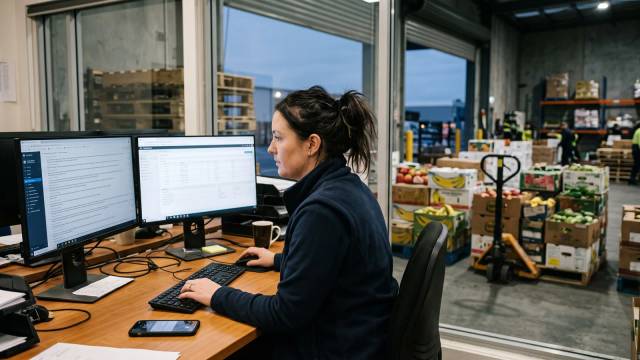
An AI agent for food distribution is software that takes a goal, such as turning the morning's emails into orders, and works out the steps itself. Useful agents read orders, answer routine questions and flag exceptions. Safe ones still send price changes, credits and anything that moves money to a person to approve.
Key takeaways
- An AI agent decides its own steps toward a goal; automation follows fixed rules you set in advance.
- Hand AI the high-volume work first: reading orders, routine price and stock questions, drafting POs.
- Keep price changes, credits, refunds and payment terms human-approved: draft, then approve.
- Gartner predicts over 40% of agentic AI projects will be cancelled by the end of 2027.
- Ask vendors to show low-confidence handling, undo, data access and learning on screen, not in slides.
- ABS: 14% of Australian wholesale businesses used AI in 2024-25, against 12% of all businesses.
In this guide 9 sections
- 01What is an AI agent for food distribution?
- 02Assistant, automation or agent: what is the difference?
- 03What should an AI agent do for a food distributor?
- 04What should stay human-approved?
- 05Why "agent washing" matters when you buy
- 06How to judge an AI agent for food distribution: questions to ask the vendor
- 07Do you need an agent, an ERP, or an ordering platform?
- 08How Open Pantry helps you apply AI with a person approving the exceptions
- 09FAQs

An AI agent for food distribution is software that takes a goal, such as "turn this morning’s emails into orders", works out the steps itself and acts in your systems, rather than waiting for a person to type each instruction. The useful ones read orders, answer routine questions and flag exceptions. The safe ones still hand anything that moves money, such as price changes, credits and refunds, to a person for approval.
The word "agent" is now on half the software pitches a wholesale supplier receives. Some of those products are agents; many are chatbots or automation rules with a new label. This guide defines the terms, sets out the jobs worth handing over and the ones that should stay with your team, and gives you the questions to ask any vendor before you sign.
What is an AI agent for food distribution?
An AI agent for food distribution is a system that plans and carries out multi-step work across your ordering, stock and customer records with limited supervision. Anthropic, which builds the Claude models, draws the line clearly in its engineering guide: workflows are systems where language models and tools follow "predefined code paths", while agents "dynamically direct their own processes and tool usage" (Anthropic, December 2024).

In a wholesale warehouse, that difference looks like this. A workflow reads every email that lands in orders@ and converts it to a draft order the same way every time. An agent notices that a regular café has not ordered by its usual time, checks its last four orders, drafts a likely order and messages the customer to confirm. The second one is choosing what to do next. That is what makes it an agent, and it is also what makes it riskier.
Assistant, automation or agent: what is the difference?
Most AI for wholesale distributors falls into one of three groups. Knowing which one you are being sold tells you how much checking it needs.
- Assistant. It answers when asked. You paste a supplier price list and ask for a summary, or ask "what did the Fitzroy pub order last Thursday?". It does nothing on its own.
- Automation. It follows rules you set. "If an order arrives after the 5pm cut-off, move it to the next delivery day." It is predictable, and it breaks when something falls outside the rules.
- Agent. It is given a goal and decides the steps. It can read, look things up, draft and, if allowed, act. It handles messy inputs well, and it needs guardrails because it makes choices.
Many good products blend the three. An AI order capture tool can use an AI model to read a handwritten order sheet, then apply a fixed rule to decide whether the result is confident enough to place. That is closer to automation with AI inside it than to a free-roaming agent, and for most suppliers that is the right place to start.
What should an AI agent do for a food distributor?
An AI agent for a food distributor should take on high-volume, low-judgement work where a mistake is cheap to catch and fix. Four jobs fit that description.

Read and enter orders
This is where AI already earns its keep. Orders arrive by email, PDF, SMS, WhatsApp, photos of order sheets and voicemail, and someone types them in before picking can start. An AI that reads the message, matches customer shorthand ("2 x toms, the usual cos") to product codes and builds the order saves that typing. Our explainer on how AI order entry works for food wholesalers walks through each channel.
Answer routine pricing and stock questions
"Is the Wagyu rump back in?" "What’s my price on 10 kg onions?" These questions interrupt sales reps and admin staff all day. An agent with read access to your price lists and stock availability can answer them in the customer’s own channel, using that customer’s specific pricing, without being able to change either.
Chase exceptions
Short picks, missing product codes, orders for a customer on stop credit, an order that is double last week’s quantity. An agent can spot these, gather the context and put them in front of the right person with a suggested action, rather than letting them surface at 5am in the warehouse.
Draft purchase orders
Based on stock on hand, open customer orders and supplier lead times, an agent can draft the next purchase order to your growers or processors. A buyer then checks it before it goes out. Drafting is the time-consuming part; approval takes a minute.
What should stay human-approved?
Anything that changes what a customer pays, what you pay, or what money moves should stay human-approved. That covers price changes and customer-specific pricing, credits and refunds, write-offs, changes to payment terms or credit limits, and purchase orders above a set value.
The safe pattern is draft-then-approve. The agent does the reading, the matching and the drafting. A person approves the final step that has consequences. You keep most of the time saving while the decisions that affect margin and cash flow stay with someone who is accountable for them.
This matches the Australian Government’s Guidance for AI Adoption, published on 21 October 2025, which condenses the earlier ten voluntary guardrails into six essential practices (Department of Industry, Science and Resources). One of the six is "Maintain human control", described as integrating meaningful human oversight (White & Case summary, 25 November 2025). For a supplier, meaningful oversight does not mean checking every order line. It means a person signs off on decisions that move money and can see what the system did and why.
Why "agent washing" matters when you buy
Not everything sold as an agent is one, and not every agent project succeeds. Gartner predicted in June 2025 that more than 40% of agentic AI projects will be cancelled by the end of 2027, citing escalating costs and unclear business value. It also warned of "agent washing", where chatbots and assistants are rebranded as agents, and estimated that only about 130 of the thousands of vendors claiming agentic AI are real (Reuters report via The Star, 25 June 2025).
Adoption is still early in Australia. The ABS found 12% of Australian businesses used AI in 2024–25. Wholesale trade was slightly above that average at 14%, and accommodation and food services, your customers, sat at 5% (ABS, Characteristics of Australian Business, released 25 June 2026). You are not late. You do have time to buy carefully.
The label matters less than the behaviour. As at 3 November 2026, Choco markets a product named OrderAgent, and its own page says its Autopilot mode sends verified orders straight to the customer’s ERP and routes others for human review (Choco). That is a confidence threshold with a person on the exceptions, and you should judge it that way, whatever it is called.
How to judge an AI agent for food distribution: questions to ask the vendor
Before you buy, ask every vendor these questions, and ask them to show you the answer on screen rather than describe it.
- Does it show its working? For any order or answer, can you see the original message beside what the AI produced and why it matched each line?
- What happens when it is not sure? Is there a confidence threshold, who sets it, and where do low-confidence orders go? "It is always right" is not an answer.
- Can you undo it? If the agent places a wrong order or sends a wrong reply, how quickly can you reverse it, and is there a log of what it did?
- What data does it use, and what can it change? Read access to price lists is different from write access. Ask for the list of actions it is allowed to take.
- Does it learn, and from what? When your team corrects a match, does the system remember it next time, or does the same mistake come back every Monday?
- How is it priced? Per order, per seat, per message or a flat fee. Work out the cost at your real order volume, including your busy season.
- What does it connect to? Your accounting software, your pick lists and your delivery runs. An agent that cannot reach your order-to-invoice workflow just moves the typing somewhere else.
A good vendor will be comfortable with all seven. A vendor that avoids the fourth or fifth question is telling you something. Our comparison of AI order entry software for food wholesalers applies these tests to the main products available today.
Do you need an agent, an ERP, or an ordering platform?
Most Australian food distributors do not need an "agent" as a separate product. They need AI built into the place where orders, prices, picking and invoices already live. An ERP runs finance, purchasing and inventory across a large business. An ordering and operations platform runs the daily order-to-invoice flow and syncs to your accounting software. AI order capture works best inside whichever system holds your catalogue, customer pricing and order history, because that is the context it needs to match orders correctly.
How Open Pantry helps you apply AI with a person approving the exceptions
Open Pantry is an Australian B2B ordering and operations platform for wholesale food and beverage suppliers, founded in 2018. It is not an ERP and we do not sell it as an autonomous agent. Its AI order capture reads orders from email, PDFs, photos, SMS, WhatsApp and transcribed voicemail. Every order gets a confidence score: above a threshold you set, it is placed automatically; below it, a person checks it beside the original message. Matches your team confirms are remembered next time. Orders then flow into digital pick and pack, invoicing and accounting sync. AI ordering is on the Enterprise plan; see supplier pricing. Judge any vendor, including us, on that behaviour rather than the label.
Frequently asked questions
What is an AI agent for food distribution?
An AI agent for food distribution is software that takes a goal, such as turning the morning's emails into orders, and works out the steps itself across your ordering, stock and customer records. It differs from an assistant, which only answers when asked, and from automation, which follows fixed rules. Good agents still hand price changes, credits and anything that moves money to a person to approve.
What jobs should a food wholesaler hand to an AI agent first?
Start with high-volume, low-judgement work where mistakes are cheap to catch: reading and entering orders from email, SMS, WhatsApp, PDFs and voicemail; answering routine price and stock questions from read-only data; flagging exceptions such as short picks or unknown product codes; and drafting purchase orders for a buyer to check. Keep pricing, credits, refunds and payment terms human-approved.
How can I tell if a vendor's AI agent is real or just a chatbot?
Ask the vendor to show, on screen, what the system does without being asked, what actions it is allowed to take, how it handles low confidence and how you undo a mistake. Gartner has warned about agent washing, where chatbots are relabelled as agents, and estimated only about 130 of thousands of agentic AI vendors are real. Judge behaviour, not the product name.
Is it safe to let AI accept wholesale orders without checking them?
It can be, if the system scores its confidence on every order and only auto-accepts orders above a threshold you set. Orders or lines below that threshold should go to a person to check against the original message. Start with a high threshold, review the results for a few weeks, and lower it only when the error rate on auto-accepted orders is consistently low.
Can you recommend the best ERP solutions for food distributors?
It depends on what you need the system to run. A full ERP suits large distributors that also manufacture or need multi-entity finance. Many Australian food wholesalers instead pair an ordering and operations platform for orders, pricing, picking and delivery with the accounting software they already use. Look for one that syncs invoices, payments and customers to Xero, MYOB or QuickBooks so finance stays where it is.
Sources
- Anthropic - Building effective agents (workflows vs agents, human checkpoints), 19 December 2024, accessed 3 November 2026
- Australian Government, Department of Industry, Science and Resources - Guidance for AI Adoption (6 essential practices, published 21 October 2025), accessed 3 November 2026
- White & Case - Australia launches new AI guidance (six practices incl. 'Maintain human control'; replaces 10 VAISS guardrails), 25 November 2025, accessed 3 November 2026
- Reuters via The Star - Over 40% of agentic AI projects will be scrapped by 2027, Gartner says (agent washing, ~130 real vendors, 33% of enterprise apps by 2028), 25 June 2025, accessed 3 November 2026
- Australian Bureau of Statistics - Characteristics of Australian Business 2024-25 (AI use 12% all businesses, 14% wholesale trade, 5% accommodation and food services), released 25 June 2026, accessed 3 November 2026
- Choco - OrderAgent (Autopilot sends verified orders to ERP, routes others for human review), accessed 3 November 2026
- Open Pantry - AI Order Capture (channels incl. voicemail, supplier-set confidence threshold, remembered matches, Enterprise plan, prepaid credit wallet), accessed 3 November 2026
- Open Pantry - Supplier pricing and plans (AI ordering on Enterprise), accessed 3 November 2026