


To calculate food cost percentage, divide a dish's ingredient cost by its menu price ex GST and multiply by 100. In Australia, divide the menu price by 1.1 first: a $6.60 plate on a $29 menu price is 25.0%, not 22.8% (illustrative). Most Australian venues aim for 28–32% across the menu.
Key takeaways
- Food cost % = plate cost ÷ menu price ex GST × 100. Divide an Australian menu price by 1.1 first.
- In Excel, with cost in B2 and price inc GST in C2, type =B2/(C2/1.1) and format as %.
- Period food cost % = (opening stock + purchases − closing stock) ÷ food sales ex GST.
- Most Australian venues aim for 28–32% food cost across the whole menu, not on every dish.
- Cost meat after trim: with a 90% yield, divide the raw ingredient cost by 0.9.
- Weight menu food cost by units sold: a busy 35% steak outweighs a slow 20% risotto.
In this guide 9 sections
- 01What is food cost percentage?
- 02How do you calculate food cost percentage for a recipe?
- 03Food cost percentage formula in Excel
- 04How do I work out food cost percentage for my menu?
- 05How to calculate food cost for a whole period
- 06What is a good food cost percentage?
- 07Mistakes that make the number lie
- 08How Open Pantry helps you keep food cost percentage current
- 09FAQs
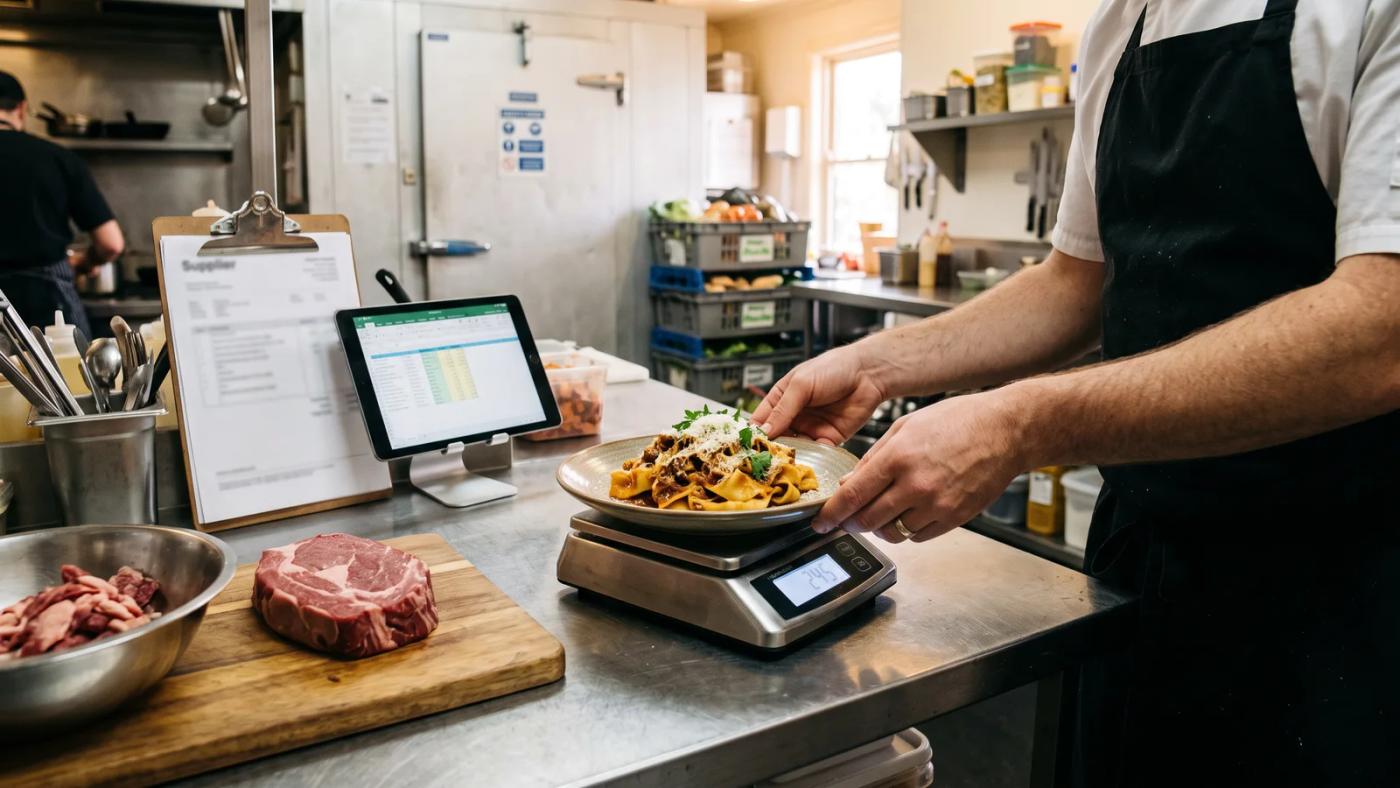
To calculate food cost percentage, divide the cost of the ingredients by the selling price and multiply by 100: food cost % = (ingredient cost ÷ menu price ex GST) × 100. A dish that costs $6.60 to plate and sells for $29 including GST has a food cost of 25.0% once you take the 10% GST out of the menu price (illustrative example).
That last step is the one most quick answers skip. In Australia your menu price includes GST, but most of what you buy from suppliers is costed ex GST, so dividing by the GST-inclusive price makes every dish look about two points cheaper than it is. This guide covers how to calculate food cost percentage for a single recipe, for your whole menu and for a trading period, the Excel formula, what a good number looks like, and the mistakes that make the answer lie.
If you need the full method for costing a recipe line by line, start with our guide on how to calculate menu costing. This article is about the percentage: what it means and how to work it out correctly.
What is food cost percentage?
Food cost percentage is the share of a dish’s selling price (or of a period’s food sales) that is spent on ingredients. If a dish has a 30% food cost, 30 cents of every dollar it earns, before GST, goes back to your suppliers, and the other 70 cents is gross profit that has to cover wages, rent, energy and profit.
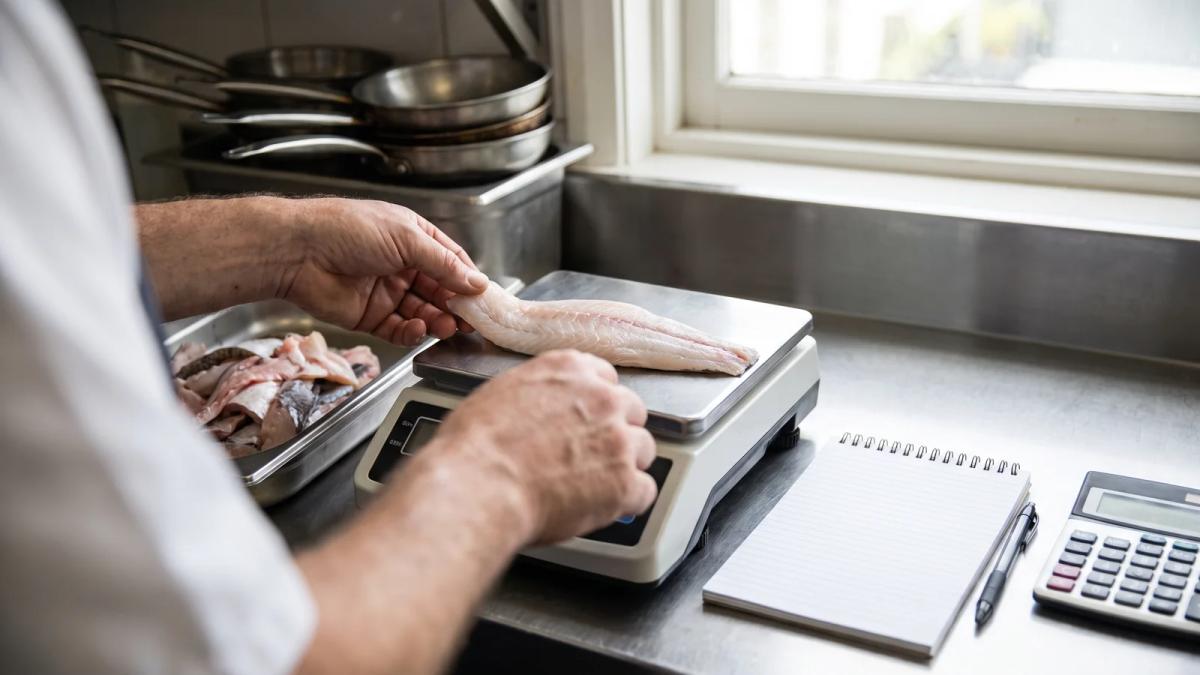
There are two versions, and they answer different questions:
- Theoretical (per-dish) food cost % is what a dish should cost if it is prepped and portioned exactly to the recipe. You use it to set menu prices.
- Actual (period) food cost % is what your kitchen really spent over a week or month, measured from stock and purchases. You use it to see whether the kitchen is running to the recipes.
The gap between the two is where waste, over-portioning, staff meals and stale prices show up.
How do you calculate food cost percentage for a recipe?
Add up the cost of every ingredient in one portion, divide by the menu price ex GST, and multiply by 100. The steps:
- List every ingredient in the portion, including oil, garnish, sauce and anything on the side.
- Cost each line from your latest supplier invoice, using the price per kilo, litre or unit ex GST.
- Adjust for yield. If you lose 10% of a cut of beef to trimming, divide its cost by 0.9 so you are paying for what reaches the plate.
- Add the lines together to get the plate cost.
- Take GST out of the menu price by dividing it by 1.1.
- Divide plate cost by the ex-GST price and multiply by 100.
Worked example: beef ragu pappardelle (illustrative numbers)
All figures below are illustrative, chosen to show the maths, not real supplier prices.
- Beef chuck at $18.00/kg, 160 g raw per portion: $2.88, divided by a 90% trim yield = $3.20
- Fresh pappardelle at $12.00/kg, 150 g: $1.80
- Ragu sauce base (passata, soffritto, wine), costed as a sub-recipe: $0.85
- Parmesan at $40.00/kg, 15 g: $0.60
- Parsley and finishing oil: $0.15
Plate cost = $6.60. Menu price = $29.00 including GST, which is $29.00 ÷ 1.1 = $26.36 ex GST.
Food cost % = $6.60 ÷ $26.36 × 100 = 25.0%. Gross profit per plate = $26.36 − $6.60 = $19.76, a gross profit margin of 75.0%.
To work backwards from a target, divide the plate cost by the target percentage and add GST back. At a 28% target: $6.60 ÷ 0.28 = $23.57 ex GST, × 1.1 = $25.93 including GST. Our free food cost calculator runs both directions and handles trim and yield per line.
Food cost percentage formula in Excel
In Excel or Google Sheets, put the plate cost in B2 and the menu price in C2, then type one of these in D2 and format the cell as a percentage (Home → Number → %):

=B2/C2=B2/(C2/1.1)=B2/E2*1.1For the pappardelle above, =6.60/(29/1.1) returns 0.2503, which displays as 25.0%. If you would rather not build the sheet yourself, the food cost calculator lets you download the dish you have costed as an .xlsx file with ingredient lines, unit dropdowns and live totals that opens in Excel, Google Sheets and Numbers. The calculator is free and needs no sign-up.
How do I work out food cost percentage for my menu?
To work out food cost percentage for your menu, cost each dish to a plate cost, divide each by its menu price ex GST, then weight the result by how many of each dish you sell. The GST step matters at the menu level because it is a consistent error across every dish.
The GST step. The ATO treats food and drink consumed on your premises as taxable, so your menu prices include 10% GST. On the buying side, basic foods such as fresh fruit and vegetables, raw meat, fish, eggs, milk and plain bread are GST-free, and where a supplier does charge GST on an item, a GST-registered business can usually claim it back as a credit. Either way, your true ingredient cost is the ex-GST figure. So compare like with like: ex-GST costs against ex-GST prices.
Using the example, dividing $6.60 by the GST-inclusive $29.00 gives 22.8%. The correct figure is 25.0%. That 2.2-point gap is the kind of error that makes a menu look healthier than it is.
Weight by sales. A menu’s food cost is not the average of its dishes’ percentages. If your 35% steak sells three times as often as your 20% risotto, the steak dominates. Multiply each dish’s plate cost by units sold, add them up, and divide by total food sales ex GST for the same period. Your POS sales report gives you the units.
For the method of costing every dish on a menu in the first place, see how to cost a menu.
How to calculate food cost for a whole period
For a week or a month, calculate food cost from stock and purchases, not from recipes:
(opening stock + purchases − closing stock) ÷ food sales × 100This is the standard period formula used by foodservice distributors such as US Foods. Count stock at cost on the same day and time each period, use purchases ex GST, and use food sales ex GST.
Illustrative example for one month: opening stock $8,400, purchases $21,600, closing stock $7,900. Cost of food used = $22,100. Food sales were $85,800 including GST, or $78,000 ex GST. Food cost % = $22,100 ÷ $78,000 = 28.3%.
A few rules keep this honest:
- Keep food and beverage separate. Drinks usually run at very different percentages, and mixing them hides problems in both.
- Count consistently. A stocktake on a Monday morning after a Sunday delivery will not compare with one on a Friday before the delivery.
- Record credits and returns against purchases, or the number will be too high.
Then compare the period figure with your theoretical, sales-weighted figure. If the recipes say 25% and the stocktake says 28.3%, about 3 points of food sales are leaving the kitchen somewhere other than on a costed plate.
What is a good food cost percentage?
Most Australian venues aim for a food cost of 28–32% across the menu, but the right figure depends on what you sell and what your rent and wages are. US Foods reports that many full-service and limited-service restaurants average 28–32%, and Open Pantry’s food cost calculator uses the same 28–32% as a typical whole-menu target for Australian venues.
Individual dishes sit well either side of that. Open Pantry’s calculator gives typical ranges of 10–20% for coffee and hot drinks, 20–28% for pasta and noodles, 25–32% for cafe breakfasts, 28–35% for burgers and pub mains, and 32–40% for steak and seafood. A steak at 38% can still be a good dish if it earns more dollars of gross profit per plate than a 22% pasta. Watch both the percentage and the dollar margin.
Mistakes that make the number lie
Most wrong food cost percentages come from the inputs, not the maths. The common ones:
- Dividing by the GST-inclusive price. Every dish reads about two points lower than reality in the example above.
- Ignoring trim and cooking loss. Cost the beef without the 90% yield and the pappardelle drops from 25.0% to 23.8% on paper. Bones, skin, outer leaves and cooking shrink are real costs.
- Costing off a stale price. If beef chuck rises from $18 to $21 a kilo, that dish moves from 25.0% to 27.0% with no change to the recipe. Recipes costed once a year drift every week.
- Forgetting the small lines. Garnish, frying oil, butter for the pan, bread on the side and sauces costed at zero add up across hundreds of plates.
- Averaging dishes instead of weighting by sales. A menu of good percentages can still run hot if the best sellers are the expensive ones.
- Mismatched periods. Purchases for one month against sales for another, or a stocktake on a different day each time.
We go deeper on these in common menu costing mistakes in restaurants.
How Open Pantry helps you keep food cost percentage current
Open Pantry is an Australian B2B ordering and operations platform for wholesale food and beverage suppliers, with restaurant ordering, inventory and menu-costing tools. For one dish, the free food cost calculator costs line by line with trim and yield, takes GST out of the menu price for you and exports an .xlsx. For the whole menu, Menu Profit Manager is a paid tool, sold as a one-off fee rather than a subscription. Because Open Pantry’s food costing software builds recipes from the products you buy, a supplier price change re-costs every dish that uses the ingredient, sub-recipes included, and flags dishes that have drifted over their target.
Frequently asked questions
How do you calculate food cost percentage in a restaurant?
Divide the ingredient cost of a dish by its menu price ex GST and multiply by 100. In Australia, menu prices include 10% GST, so divide the menu price by 1.1 first. For the whole restaurant over a period, use opening stock plus purchases minus closing stock, divided by food sales ex GST. Compare the two figures to find waste and portioning problems.
How do restaurants calculate food cost each week or month?
Most restaurants count stock at cost at the start and end of the period, add purchases ex GST (less credits), and divide the result by food sales ex GST for the same dates. Doing the stocktake on the same day and time each period, and keeping food and beverage separate, makes the number comparable from one period to the next.
Should food cost percentage use the menu price with or without GST?
Use the menu price without GST. Your ingredient costs are effectively ex GST, because many basic foods are GST-free and GST on other purchases can usually be claimed as a credit. Dividing ex-GST costs by a GST-inclusive price understates food cost: in our illustrative example a 25.0% dish shows as 22.8%.
What is the food cost percentage formula in Excel?
With plate cost in B2 and a GST-inclusive menu price in C2, type =B2/(C2/1.1) and format the cell as a percentage. If the price is already ex GST, use =B2/C2. To find the menu price for a target food cost in E2, use =B2/E2*1.1. Open Pantry's free calculator exports a ready-made .xlsx.
Are there free tools available for recipe costing and menu pricing?
Yes. Open Pantry's food cost calculator is free with no sign-up: it costs a dish line by line with trim and yield, handles GST, suggests a menu price at your target food cost and downloads the dish as an Excel file. Ongoing costing of a full menu that updates with supplier prices is a paid product.
Sources
- Australian Taxation Office - How GST works (accessed 13 October 2026)
- Australian Taxation Office - Taxable food (accessed 13 October 2026)
- Australian Taxation Office - GST-free food (accessed 13 October 2026)
- US Foods - How to Track Your Food Cost Percentage & Drive More Revenue (accessed 13 October 2026)
- Open Pantry - Free food cost calculator (accessed 13 October 2026)
- Open Pantry - Restaurant food costing software Australia (accessed 13 October 2026)
- Open Pantry - Restaurant pricing (accessed 13 October 2026)


