

The Real Cost of Manual Order Management in a Wholesale Food Business

Ask most wholesale food suppliers whether manual order management is costing them money, and the honest answer is usually: “Probably, but I’m not sure how much.”
That uncertainty is part of the problem. Manual processes rarely create one obvious expense. Instead, the costs are spread across admin wages, delivery mistakes, credit notes, staff frustration, lost productivity, and customers who quietly move to suppliers that are easier to order from.
Because these costs are hidden inside normal business activity, they are easy to underestimate. But if your team is still taking orders by phone, text, email, spreadsheets, or handwritten notes, those costs are already affecting your margins.
The real question is whether you can see them clearly enough to act.
1. The Time Cost
Start with the most obvious cost: staff time.
In a growing wholesale food business, it is common for someone to spend around two hours each working day managing orders. That might include answering calls, reading texts, entering orders into a spreadsheet, checking unclear requests, confirming details with customers, and preparing information for the warehouse or delivery team.
Two hours a day, five days a week, across a full year equals 520 hours.
At an average administrative wage of $28 to $35 per hour, including superannuation and on-costs at Australian rates, that works out to roughly $14,560 to $18,200 per year. That is only for order intake and basic order management.
For many suppliers, the real cost is higher. Manual order work is often spread across multiple people throughout the day, creating constant interruptions and context switching. A quick phone call, a half-entered text order, or a customer chasing confirmation may not look expensive on its own. Added together, these small interruptions consume a large amount of productive time.
This is one reason many suppliers start looking at wholesale order management for foodservice suppliers as order volumes increase. When customers place orders through a portal, the need for manual transcription is reduced. When orders flow directly into pick lists or fulfilment workflows, staff spend less time formatting, checking, and re-entering information.
For many suppliers, a well-implemented system can reduce order administration time by 60 to 80%.
2. The Error Cost
Manual order entry always carries some level of error risk.
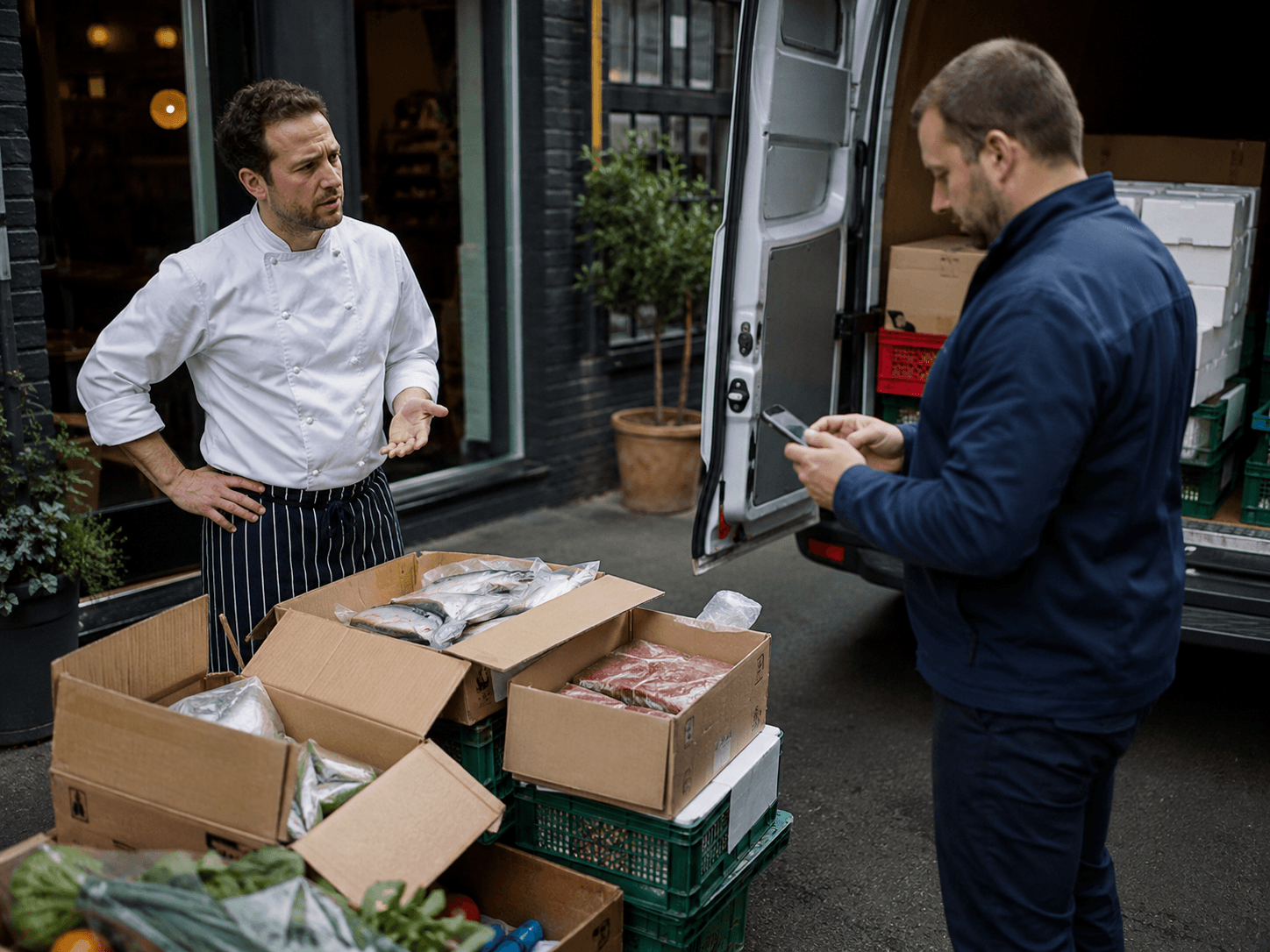
A handwritten note can be misread. A text message can be copied incorrectly. A customer might ask for “four cases” and the order is entered as four units. These mistakes are not always caused by carelessness. They are the natural result of busy teams trying to process detailed order information under pressure.
Each error creates more than one cost.
There may be a re-delivery cost, including fuel, driver time, and vehicle expenses. There may be a credit note to process, which reduces revenue and adds more admin work. If perishable goods were picked incorrectly, there may also be waste or stock that cannot easily be resold. On top of that, the original picking and packing time has already been spent.
Even a modest error rate can add up quickly.
If a supplier processes 100 orders per week and 3% require correction, that is three order issues per week, or around 150 incidents per year. At a conservative resolution cost of $50 to $100 per incident, that is $7,500 to $15,000 per year in direct error costs.
That figure does not include the long-term impact on customer trust. As explained in this article on the real cost of manual order entry for foodservice suppliers, the problem is not just typing in the order. It is the mistakes, delays, invoice corrections, missed messages, and customer frustration that build up over time.
3. The Growth Ceiling
The biggest cost of manual order management is not always what it costs today. It is what it prevents the business from doing next.
When order management depends on manual work, growth depends heavily on admin capacity. Every new customer brings more calls, messages, order changes, and follow-ups. Every new product adds more complexity to price lists, pick lists, and fulfilment.
At some point, growing from 80 orders a week to 200 orders a week does not just mean being busier. It can mean needing more admin staff simply to keep the same process running.
That creates a ceiling.
The business may still have market demand, strong products, and loyal customers, but the internal system cannot scale efficiently. Some suppliers mistake this for a market limit, when the real issue is an operational limit.

4. The Hidden Churn Cost
Restaurants, cafés, and catering businesses are busy. They want ordering to be fast, clear, and reliable.
If placing an order means calling during a narrow window, waiting for a confirmation, sending follow-up messages, or checking whether the order was received, the experience becomes frustrating. Over time, some customers will choose a supplier that makes ordering easier.
They may not complain before they leave.
The orders may simply become less frequent. Then they stop. By the time the account looks inactive, the customer relationship may already be gone.
For wholesale food suppliers, retention is where a large part of the margin sits. Losing customers because of ordering friction is expensive, but it is often difficult to see until it has already happened.
5. The Opportunity Cost
There is also the cost of what your team could be doing instead.
A capable operations person spending two hours a day on manual order entry is not spending that time improving supplier relationships, reviewing product performance, reducing delivery inefficiencies, strengthening customer service, or working on process improvements.
That lost opportunity may not appear on a financial statement, but it still affects the business.
Good people should not be spending a large part of their day copying order details from one place to another. When skilled staff are tied up in repetitive admin, the business loses both time and momentum.

What the Numbers Look Like with Software
A wholesale management platform for a mid-sized Australian food supplier might cost around $300 to $800 per month, depending on order volume, features, and support.
Compared with the costs outlined above, the return can become clear quickly. A supplier may already be losing more than $14,000 per year in admin time, another $7,500 or more in order correction costs, and additional margin through churn, missed growth, and low-value manual work.
This is especially true for suppliers still relying on spreadsheets. As covered in the hidden cost of spreadsheets for wholesale suppliers, spreadsheet-driven workflows can quietly create margin leaks, order mistakes, stock issues, and invoicing delays.
Open Pantry helps reduce these costs by moving orders into one cleaner system, giving customers an easier way to order, and helping suppliers manage orders, picking, delivery, and invoicing with less manual admin.
Once the true cost of manual order management is measured, the case for a better system becomes much easier to see.
A Better Way Forward
Manual order management can feel manageable for a long time. But as order volumes grow, the hidden costs become harder to ignore. Admin time increases. Errors become more expensive. Customers expect faster ordering. Staff become stretched. Growth becomes more difficult to support.
Open Pantry helps wholesale food suppliers reduce manual admin, improve order accuracy, and create a smoother ordering experience for their customers.
See how Open Pantry can help reduce manual admin and simplify order management. Book a demo today!