


The Hidden Cost of Spreadsheets for Wholesale Suppliers

Spreadsheets are the default operating system for wholesale foodservice. They’re familiar, fast, and practically free—so it makes sense that many suppliers run pricing, product catalogues, customer lists, and even orders in Excel or Google Sheets.
And early on, they work.
But as you grow, spreadsheets start to create the kind of problems that don’t show up on a balance sheet until it’s too late: margin leakage from inconsistent pricing, time lost reconciling versions, catalogue mess that confuses customers, and order data that isn’t structured enough to run a warehouse cleanly. What used to be a simple file becomes the backbone of your operation—and it’s a fragile one.
This article breaks down where spreadsheets typically fail in wholesale, the real costs that come with that failure, and what scalable suppliers replace them with as complexity increases.
The Quiet Financial Risks Hiding Inside Your Spreadsheet Workflows
1. Margin Leakage (the silent profit killer)
Margin leakage is the most common spreadsheet cost because it’s rarely obvious in the moment. A product selling for $1 less than intended doesn’t trigger an alarm—it just quietly reduces profit on every order.
This happens when:
- price updates aren’t rolled out everywhere (or aren’t applied to every customer)
- staff use an older version of the price list
- pack sizes or units are selected incorrectly (carton vs kg vs each)
- a cost changes but the spreadsheet margin calculation doesn’t
- discounts and special pricing are applied inconsistently across the team
The real danger is that undercharging can persist for months. Many suppliers only discover it later when they do a deep review and realise the “right price” and the “charged price” have drifted over time.

2. Order Entry Errors That Ripple Through The Warehouse
Manual order entry and copy/paste is where small mistakes turn into big operational problems. A missed note, a duplicated row, or one overwritten cell can become:
- wrong quantities picked
- missing items
- urgent repicks
- last-minute substitutions
- credits and disputes
- delayed deliveries and unhappy customers
Warehouses rely on clean data. If the input is messy, everything after it becomes expensive. This is why spreadsheet-based order capture tends to break first when order volume grows.
How to Transition Restaurant Customers to Digital Ordering
3. Version Chaos and “Multiple Sources of Truth”
When pricing, products, and customer rules live across multiple sheets (or multiple tabs maintained by different people), the team ends up operating without a reliable “single source of truth.”
It’s common to see:
- one sheet for the catalogue, another for pricing, another for costs
- special customer pricing stored in separate files
- freight rules living in someone’s notes or memory
- stock levels tracked separately from ordering sheets
The result is operational drift: the customer sees one thing, sales enters another, the warehouse picks based on a third, and accounts invoices from a fourth.
4. Key-person Dependency (scaling becomes fragile)
Most suppliers eventually have one or two people who “know the spreadsheet.” They understand the hidden logic, the exceptions, and how everything is stitched together.
If they’re sick, on leave, or leave the company, you don’t just lose a staff member—you lose:
- pricing knowledge and special agreements
- catalogue structure and product codes
- customer-specific rules and freight logic
- the ability to confidently update the system
That’s not a sustainable way to scale.

5. Invoicing Delays and Slower Cash Flow
Spreadsheets introduce delays because invoices typically can’t be created until order data has been cleaned and validated manually. That lag creates:
- delayed invoicing
- slower cash collection
- more admin time per order
- higher chance of disputes (“that’s not what we ordered”)
Even a one- or two-day invoicing delay can compound across the month and impact cash flow—especially for fast-moving suppliers.
The Supplier’s Guide to Getting Paid Faster with Automated Invoicing
6. Poor Stock Visibility and Costly Oversells
Inventory in spreadsheets is rarely real-time. Adjustments get missed, substitutions aren’t tracked properly, and stock counts drift away from reality.
That leads to:
- overselling key lines
- emergency purchases at worse pricing
- extra time spent calling customers about out-of-stocks
- avoidable waste, especially in fresh categories
When stock accuracy isn’t dependable, the entire promise you make to customers becomes harder to deliver consistently.
Where Open Pantry fits (and why it’s relevant)
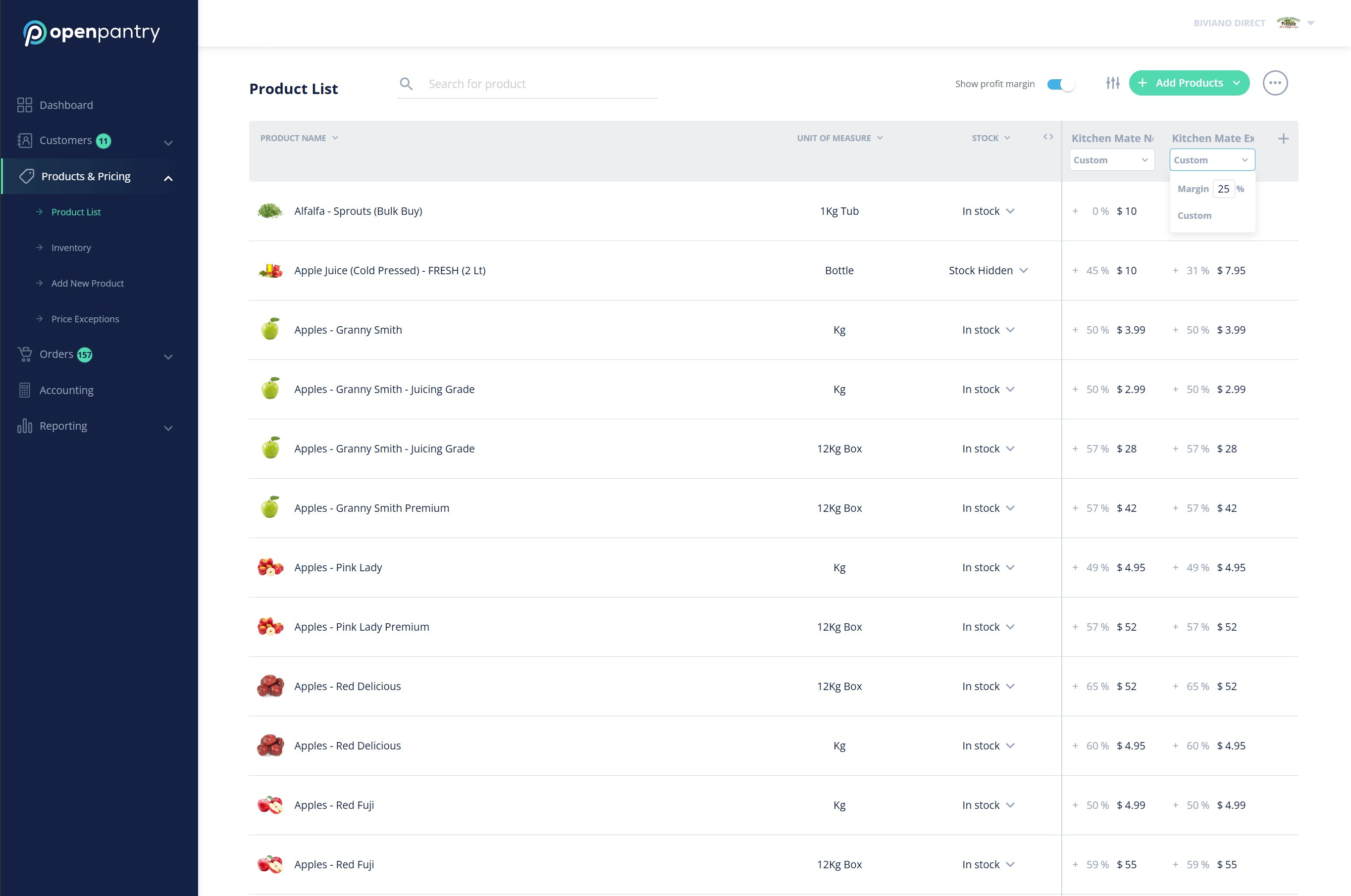
Open Pantry is built for wholesale foodservice suppliers to replace spreadsheet-driven ordering and fulfilment with one connected workflow. It centralises pricing (including customer-specific rules), customer-specific catalogues, and structured digital orders—so picking, delivery outputs, and invoicing flow cleanly without manual re-keying or spreadsheet cleanup. The result is fewer errors, less admin, and better margin control.
Spreadsheets feel “free,” but once you factor in margin leakage, repicks/credits, admin hours, and invoicing delays, they become expensive. The bigger you get, the more small errors compound into daily operational issues.
If you’re still managing pricing, catalogues, and orders in spreadsheets, don’t overhaul everything at once—start by comparing your current workflow to a connected system designed for scale.
Want to reduce admin time and protect pricing as you grow? Explore Open Pantry today!