

Signs Your Wholesale Food Business Has Outgrown Spreadsheets

Your spreadsheet probably isn’t broken — your business has just outgrown it.
Spreadsheets are a sensible place for wholesale food suppliers to start: they’re free, familiar, and flexible. But as orders, customers, pricing, delivery rules, and staff responsibilities grow, the same spreadsheet that once kept things simple can start creating delays, errors, and unnecessary admin.
If order admin is already taking up more time than it should, you may also find this article on the real cost of manual order entry for foodservice suppliers useful, as it looks at how email, text, WhatsApp, and handwritten orders create hidden costs as volume grows.
This article will help you spot the signs that your spreadsheet is no longer supporting your business — it’s quietly holding it back.
The 7 Warning Signs
1. You're Spending More Time Maintaining The System Than Running Orders
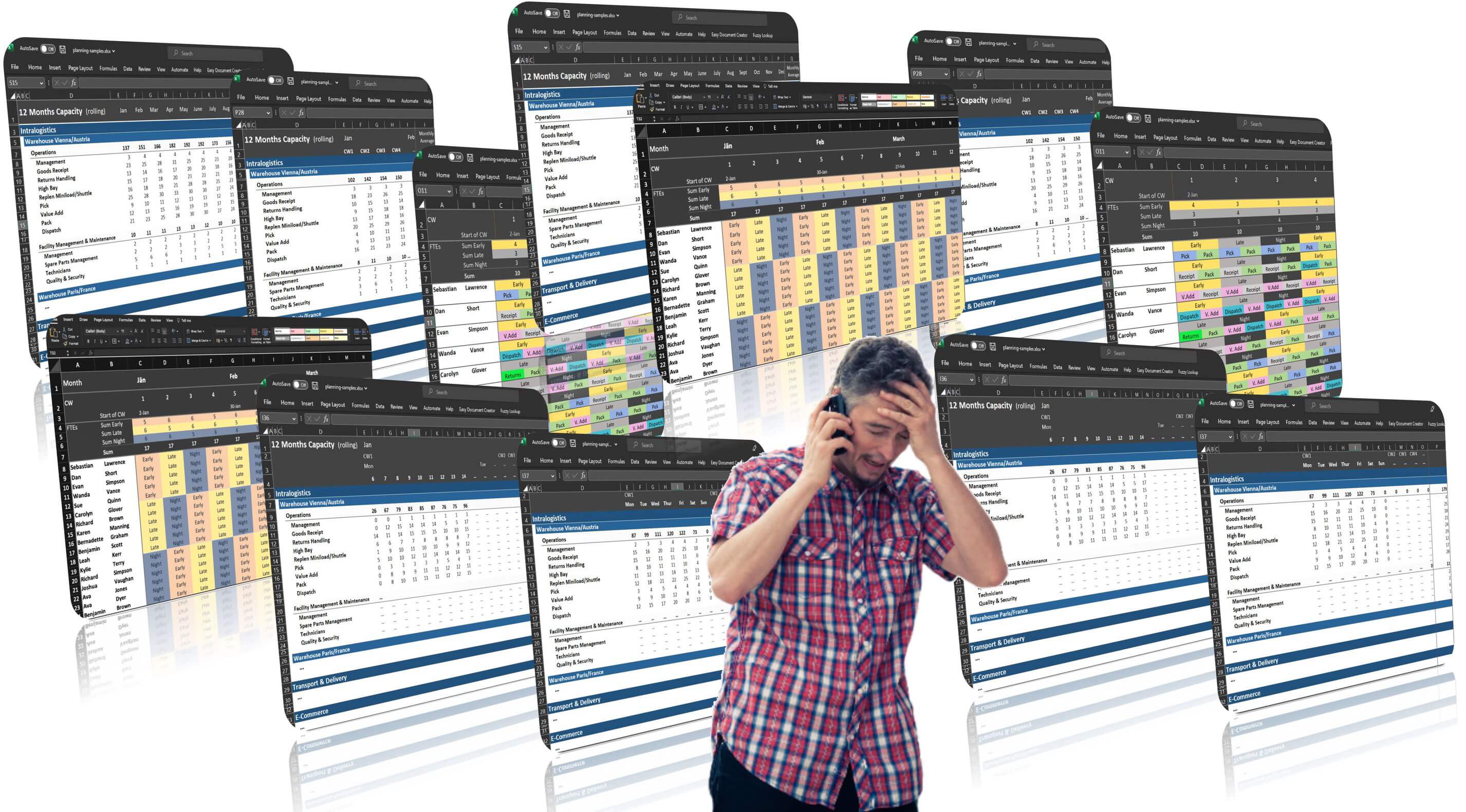
When the spreadsheet was simple, it took minutes to update. Now you've got multiple tabs, formulas that break when someone edits the wrong cell, conditional formatting that only the person who built it understands, and a weekly ritual of cleaning up entries that didn't come through correctly.
If maintaining the tool has become a significant part of someone's job, that's not a sign of good organisation — it's a sign the tool is generating work rather than reducing it.
2. Order Errors Are Increasing And You're Not Sure Why
Wrong items picked, quantities misread, orders missed entirely. When errors start creeping up and you can't easily trace them back to a root cause, it usually means your data is fragmented.
Orders are coming in through multiple channels, being transcribed by hand into the spreadsheet, and somewhere in that process, mistakes are happening. You fix each error as it comes, but you're never fixing the underlying system.
For suppliers seeing mistakes flow through to fulfilment or delivery, this piece on cutting delivery mistakes with order management software is a useful follow-up.

3. Your Team is Keeping Their Own Shadow Copies of Data
This is one of the clearest signals. When people stop trusting the central spreadsheet and start maintaining their own lists — a driver with a handwritten run sheet, a picker with their own copy of the order, someone in accounts with a separate log of what was invoiced — you've got a data integrity problem.
The “single source of truth” has fractured, and now reconciling those versions is someone's unofficial full-time job.
4. Customers Are Calling, Texting, and Emailing To Place Orders
You might have a system for receiving orders, but if customers aren't using it — or there isn't really a system for them to use — orders are arriving through every channel simultaneously. Phone calls during pack time, text messages overnight, emails to the wrong address.
Each one needs to be manually entered. Each one is a potential error. And each one is taking time that should be going elsewhere.
This is where many suppliers start looking at ways to reduce manual ordering altogether. Open Pantry has covered this in more detail in its article on how wholesale food suppliers can eliminate manual orders forever.
5. You Can't Easily Answer Basic Questions About Your Own Business
“Who ordered last week?” “What's my best-selling product this month?” “Which customers haven't ordered in three weeks?”
These should be trivial questions. If answering any of them requires digging through multiple tabs, cross-referencing dates, and manually counting entries, your data isn't working for you.
In a spreadsheet environment, reporting tends to be the thing that falls off the list when things get busy — which is exactly when you need it most. For more on this, the article on using supplier data to increase sales without hiring more staff explains how everyday order and customer data can become a practical growth tool.

6. Your Cutoff Times Are Inconsistent Because You're Chasing Orders Manually
Cutoff times exist to protect your picking and packing schedule. But when orders come in informally, there's always pressure to “just squeeze this one in.”
A good customer calls at 4pm for a 2pm cutoff. You want to keep them happy. You manually add it. Then you stay back late to get it packed.
The cutoff becomes a guideline rather than a boundary, and your whole delivery schedule starts to slip. This isn't a discipline problem — it's a systems problem. When there's no automated cutoff enforcement, it lands on a person to enforce it, and that person is usually too busy to hold the line.
7. You've Tried To Get Someone Else To Manage The Spreadsheet And It Went Badly
The spreadsheet works because one person built it and knows all its quirks. When that person is on leave, or you try to hand it off, things fall apart quickly.
Formulas break. Data gets entered in the wrong format. Columns get accidentally deleted. If your order management system can only be safely operated by one specific person, it's not a system — it's a single point of failure.
What Spreadsheets Are Actually Costing You
The cost of staying on spreadsheets is rarely visible on a balance sheet, which is why it's so easy to underestimate. But it's real, and it compounds over time.
Time: If someone is spending 2 hours a day on manual order entry, reconciliation, and spreadsheet maintenance, that's over 500 hours a year. At $25–$35 per hour in Australian labour costs, that's $12,000–$18,000 in staff time annually, doing work that a purpose-built system would handle automatically.
Errors: A single wrong delivery costs you the re-delivery run, the credit note, and — harder to quantify — the erosion of trust with a customer who's running a kitchen that depends on you showing up with the right product.
Staff frustration: Good people don't enjoy spending their days doing repetitive data entry and chasing down order details. If your admin team is spending half their time on work that feels pointless, that's a retention risk.
Customer churn risk: Restaurant and café customers are busy. If ordering from you is more friction than ordering from a competitor, some of them will quietly switch. They rarely tell you why. You just notice the orders stop coming.
Inventory issues often show up at the same time as spreadsheet issues. If stock discrepancies, picking mistakes, or unclear product availability are part of the problem, this article on inventory management for food suppliers is worth reading next.
What The Alternative Looks Like
A purpose-built wholesale supplier platform doesn't just move your spreadsheet online. It fundamentally changes how orders flow through your business.
Your customers get their own ordering portal — a simple, mobile-friendly interface where they can see your current product list, their order history, and place their order without calling anyone.
Orders land in your system automatically, already formatted for picking and packing. Cutoff times are enforced by the system, not by a person. Reports run themselves. And when someone new joins your team, the system is the same for everyone — there's no institutional knowledge locked in one person's head.
For suppliers comparing different platforms, Open Pantry’s comparison of Open Pantry, Ordermentum, and Fresho gives a broader view of how wholesale food management systems differ.
The transition isn't always instant, and good software takes some setup. But most wholesale food businesses that make the switch wonder why they waited.
Open Pantry was built specifically for wholesale food suppliers who've hit this wall. If any of these signs sound familiar, it might be time to look at what modern tools can do for your business.
Ready to move beyond spreadsheets? See how Open Pantry helps wholesale food suppliers manage orders, customers, and fulfilment with less manual admin!