

Wholesale Food Ordering Automation Guide (2026)

If your team is still managing orders through emails, texts and spreadsheets, growth may already be slowing you down.
As volumes increase and customer requirements become more complex, manual processes quickly become the biggest constraint on a supplier’s ability to scale. What once felt manageable becomes inefficient, error-prone and difficult to control.
This article outlines the key stages of the wholesale ordering workflow that suppliers should automate — from order intake and pricing to fulfilment, delivery and invoicing — and explains how the right systems reduce admin, protect margins and create operational consistency.
Modern supplier platforms like Open Pantry are purpose-built for foodservice operations, giving suppliers the tools to scale efficiently without increasing headcount.
7 Wholesale Ordering Processes Suppliers Should Automate
Automation does not require enterprise-level systems. The most meaningful improvements often come from simplifying and standardising everyday operational tasks.
1. Order Intake Consolidation
Wholesale suppliers typically receive orders through email, text messages, phone calls and multiple messaging apps. These orders are often manually re-entered into accounting systems or spreadsheets, creating duplication and increasing the risk of error.
Automating order intake into one central dashboard ensures no order is missed, eliminates repetitive data entry and gives the warehouse a clean, structured starting point every morning.

2. Customer-Specific Pricing & Product Visibility
Wholesale pricing structures are rarely uniform. Contract pricing, negotiated rates, promotional deals and franchise agreements create layers of complexity that spreadsheets struggle to manage reliably.
A rules-based pricing engine automatically applies the correct pricing per customer, controls product visibility, enforces delivery days and minimum order values, and updates changes instantly across the system. This protects margins, reduces pricing disputes and removes reliance on manual adjustments.
3. Cut-Off Reminders & Order Confirmations
Late orders and forgotten cut-offs disrupt forecasting and create warehouse congestion. Automated confirmations and reminder notifications help customers order consistently and on time.
By standardising ordering behaviour, suppliers reduce last-minute changes, improve planning accuracy and create smoother operational flow.
How to Transition Restaurant Customers to Digital Ordering
4. Automatic Pick List Generation
Manual pick sheet preparation slows fulfilment and introduces avoidable mistakes. Automated digital pick lists, generated instantly from confirmed orders and grouped logically by delivery run or warehouse zone, improve picking efficiency and reduce double handling.
As order volumes grow, warehouse speed and accuracy become critical margin drivers — and automation ensures both scale cleanly.

5. Delivery Run Planning & Route Optimisation
Transport is one of the largest operational expenses for suppliers. Manually planning delivery runs often results in inefficient routes, unbalanced driver workloads and unnecessary fuel costs.
Automating delivery batching and route optimisation improves kilometre efficiency, balances loads and creates more predictable delivery windows for customers.
6. Digital Proof of Delivery & Automated Invoicing
Paper dockets and manual invoice entry frequently lead to billing disputes and delayed payments. Digital proof of delivery, combined with automatic invoice generation and accounting system integration, accelerates cash flow and reduces reconciliation time.
Clean financial data and faster invoicing cycles significantly improve working capital and operational clarity.
The Supplier’s Guide to Getting Paid Faster with Automated Invoicing
7. Reporting & Performance Insights
Many suppliers rely on instinct rather than data because reporting takes too long to prepare manually. Automated reporting on sales trends, top-performing products, customer frequency and margin performance enables faster, more informed decision-making.
Visibility into performance is what allows suppliers to shift from reactive operations to proactive growth strategies.
The Smarter Way to Automate Your Entire Workflow
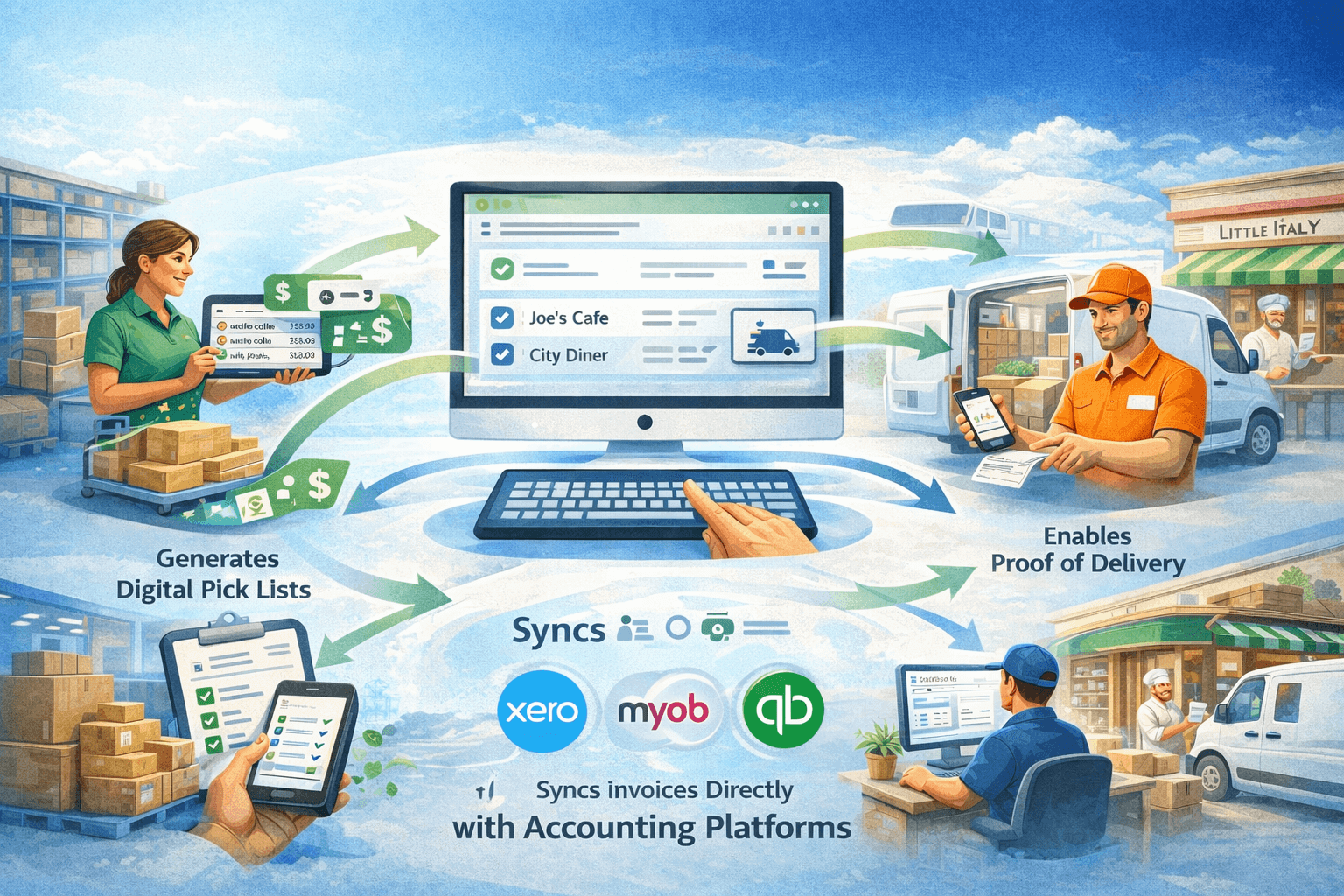
This is where Open Pantry delivers measurable impact. Open Pantry consolidates order intake into one central system, automatically applies customer-specific pricing rules, generates digital pick lists, optimises delivery runs, enables digital proof of delivery and syncs invoices directly with accounting platforms like Xero, MYOB and QuickBooks. Instead of relying on disconnected spreadsheets and manual processes, suppliers operate from a single foodservice-focused platform designed to reduce admin, protect margins and scale operations without increasing overhead. It is not just ordering software — it is operational infrastructure for sustainable growth.
What an Automated Supplier Workflow Looks Like
In a fully automated workflow, orders flow into one platform, pricing applies instantly, confirmations are sent automatically, pick lists generate without manual preparation, delivery runs are optimised, proof of delivery syncs in real time and invoices are issued immediately. Reporting updates continuously, giving management full visibility over performance.
The result is lower administrative burden, improved accuracy, stronger margins and greater confidence in scaling the business.
How Centralised Orders Improve Warehouse Efficiency Fast
Ready to Scale Without Increasing Overhead?
If your team spends more time managing orders than building revenue, automation is no longer optional. Removing spreadsheets, reducing manual corrections and creating a consistent workflow allows your operation to grow without adding unnecessary complexity.
Explore how Open Pantry can streamline your ordering, fulfilment and invoicing in one integrated platform.
Growth doesn’t come from working harder.
It comes from operating smarter.