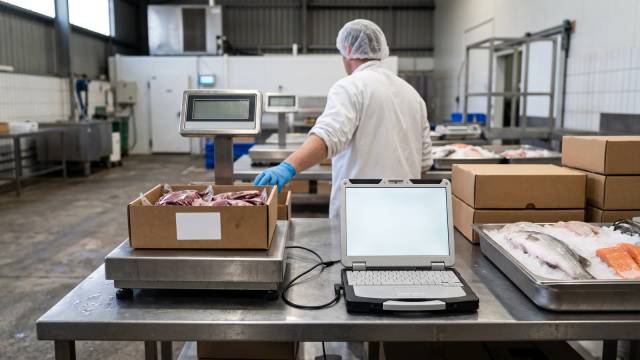
Catch weight invoicing means taking the order in units, such as cartons, whole fish or primals, and billing the kilos you actually shipped at a per-kilo price. Weigh each unit once at picking and let that weight flow to the invoice; invoicing nominal weights quietly gives away every over-weight kilo.
Key takeaways
- Catch weight: take the order in units, invoice the kilos actually shipped at a per-kilo price.
- Invoicing nominal weights gives away every over-weight kilo for free.
- In an illustrative case, a 3% weight give-away cut gross profit on a line by about 12%.
- Price per kilo when weights vary; price per unit only for fixed-weight packs.
- Weigh once at picking and let that number flow to the invoice untouched.
- Credit the weight difference against the original line, at the same per-kilo price.
In this guide 10 sections
- 01What is catch weight invoicing?
- 02Sell by the unit, invoice by the kilo: how the price works
- 03Where does margin leak when weights are estimated?
- 04Per-kilo pricing vs per-unit pricing: which should you use?
- 05How should the actual weight flow to the invoice?
- 06Credits, disputes and the weight record
- 07What do Australian trade measurement rules mean for catch weight?
- 08Questions to ask before you choose catch weight invoicing software
- 09How Open Pantry helps with catch weight invoicing
- 10FAQs
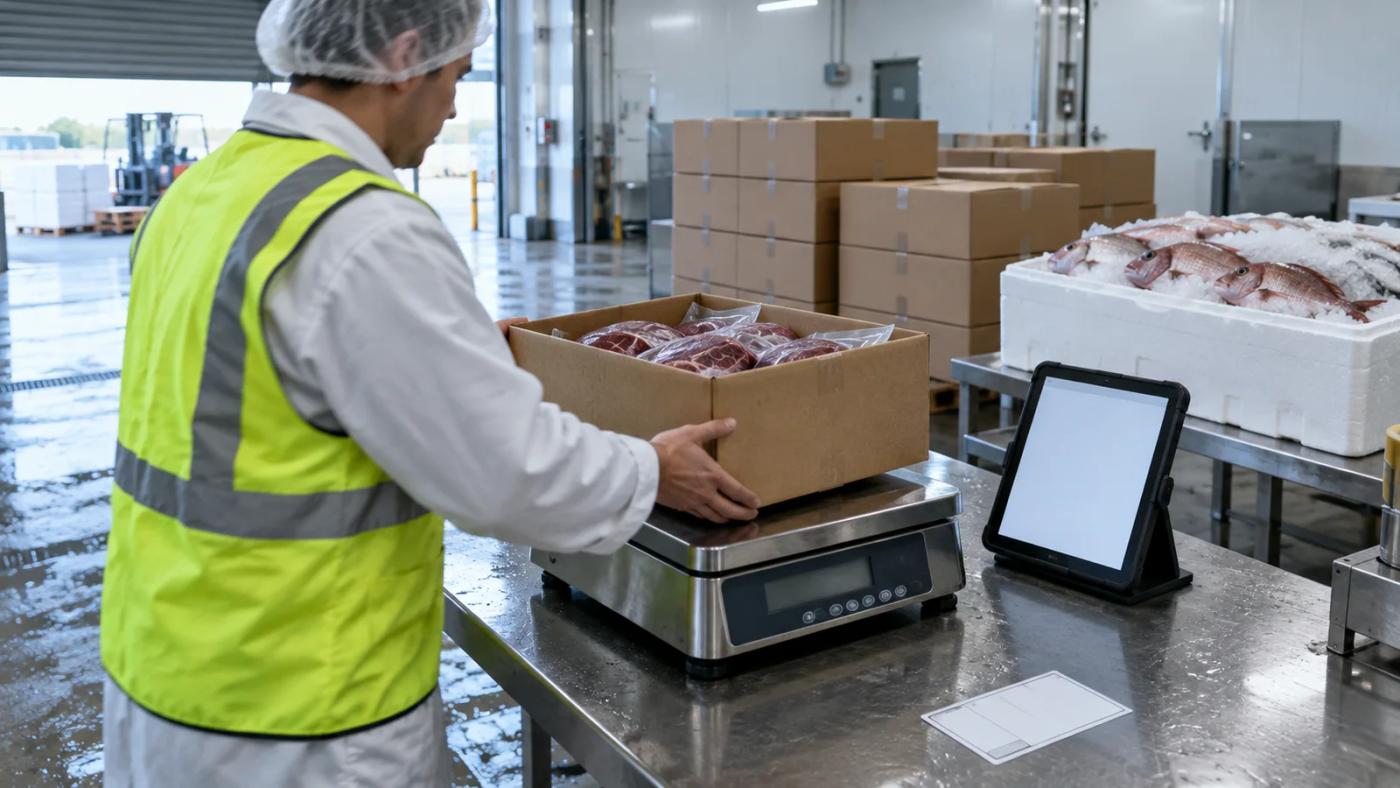
Catch weight invoicing means you take the order in units (cartons, whole fish, primals) and bill the customer for the kilos you actually shipped, at an agreed price per kilo. Done properly, every carton is weighed once at picking and that weight goes straight onto the invoice. Done badly, you invoice the nominal weight, and the gap between what you shipped and what you billed comes out of your margin, one carton at a time.
This guide is for meat, seafood, smallgoods and produce wholesalers who already sell variable weight products and want the commercial side right: how to price them, where margin leaks, how the weight should travel to the invoice, and how to handle credits when a customer queries the number. If you want the bench-side setup (connecting a scale, which scale to buy, tablets versus desktops), that is covered in our guide to catch weight with a connected scale in Pick & Pack.
What is catch weight invoicing?
Catch weight invoicing is billing a product by its actual weight when it is ordered and handled by the unit. A venue orders "two cartons of rump" or "six whole snapper", the warehouse picks two cartons or six fish, and the invoice shows the weighed kilograms multiplied by the price per kilo.
Three numbers sit behind every catch weight line:
- The ordered quantity, in the unit the customer thinks in (cartons, pieces, fish).
- The nominal or average weight, which you use to quote, take credit decisions and plan stock.
- The actual weight, which only exists once someone puts the product on a scale.
The invoice should only ever carry the third number. Everything else is an estimate.
Sell by the unit, invoice by the kilo: how the price works
The customer-facing price for a catch weight product is a price per kilo. The order line is in units, the billing line is in kilograms, and the price list holds the per-kilo rate (including any customer-specific price or price exception you have agreed).
A simple way to show it on your ordering page or price list is "Rump, carton approx. 10 kg, $18.50/kg". The customer knows roughly what a carton will cost, and they know the invoice will show the real weight. That is also how you avoid the "I ordered 10 kg, why am I paying for 10.4?" phone call: set the expectation before the order, not after the invoice.
Where does margin leak when weights are estimated?
Margin leaks in four places when the invoice does not carry the real weight:

- Invoicing the nominal weight. Cartons that come in over weight are billed at the nominal figure, so the extra kilos go out free.
- Rounding at the bench. A packer writes 10.4 as "10" on a docket to save time, or the office rounds when re-keying.
- Re-keying errors. A weight written on a pick slip is typed into the invoice later. A smudged 7 becomes a 1; a line is skipped; a weight lands on the wrong customer.
- Credits you cannot defend. When a customer says a carton was light and you have no record of the weight, the easiest answer is a goodwill credit.
An illustrative example
The figures below are made up to show the arithmetic; they are not drawn from any real business.
A meat wholesaler sells rump in cartons with a nominal weight of 10 kg at $18.50/kg, and buys it in at $14.80/kg, a 20% gross margin. Each week it ships 40 cartons that average 10.3 kg, but it invoices every carton at the nominal 10 kg.
- Kilos shipped but not billed: 40 × 0.3 kg = 12 kg a week.
- Revenue given away: 12 kg × $18.50 = $222 a week, or $10,656 over 48 trading weeks.
- Per carton, revenue stays at $185 but the cost of 10.3 kg is $152.44, so gross profit falls from $37.00 to $32.56. A 3% weight give-away takes about 12% of the gross profit on that line.
That is one product and one customer group. Run the same sum across every catch weight line and the leak becomes visible.
Per-kilo pricing vs per-unit pricing: which should you use?
Per-kilo pricing is the right default for any product whose weight varies more than your margin can absorb. Per-unit (flat) pricing works only when the weight spread is narrow or the customer will pay for the convenience.
Take whole snapper in an illustrative range of 1.6 kg to 2.4 kg, worth $16/kg. A flat price of $32 a fish assumes 2.0 kg. A 2.4 kg fish is worth $38.40, so you give away $6.40. A 1.6 kg fish is worth $25.60, so the customer overpays by $6.40 and, if they weigh it, rings you about it. Flat pricing pushes the variance onto whichever side gets the worse fish.
Use these rules of thumb:
- Price per kilo for primals, whole fish, cheese wheels, large smallgoods and anything packed to a random weight.
- Price per unit for fixed-weight retail packs, portion-controlled cuts packed to a set weight, and products where the spread is too small to matter.
- Show both on the order page (unit to order, per-kilo rate, approximate weight per unit) so the buyer can budget.
How should the actual weight flow to the invoice?
The actual weight should be captured once, at picking, against the customer’s order line, and then travel untouched to the invoice and your accounting system. Every time a person copies the number from one place to another, you add a chance of error and a delay.
A clean order-to-invoice workflow for catch weight looks like this:
- The order arrives in units, priced per kilo from the customer’s price list.
- The picker weighs each unit against that customer’s line, from the scale, from the weight on the supplier’s carton label, or by typing what the scale shows.
- The weight is checked against the expected weight, and anything outside your tolerance is flagged before it is confirmed.
- The invoice is built from the captured weight multiplied by the per-kilo price, not from the ordered quantity.
- The invoice syncs to your accounting system like any other line, with no end-of-day reconciliation of dockets against invoices.
The capture method matters less than not retyping it. In Open Pantry, for example, the connected scale (an Enterprise feature) is read through the browser’s Web Serial connection, with drivers for Adam Equipment GBK, GFK and Gladiator scales and a generic RS-232 driver, so the packer presses the scale’s PRINT key rather than copying a number. On an iPad or Android tablet, where browsers don’t allow serial connections, the packer types the weight from the scale display, and that is a fully supported flow, not a degraded one.
If your current process has a paper docket between steps 2 and 4, that docket is where most of the leakage in the list above happens.
Credits, disputes and the weight record
A weight record is what turns a disputed invoice into a five-minute conversation. When a venue says a carton was light, you want to see who weighed it, when, how the weight was captured (scale, label or typed) and what the tolerance check said.
Good practice for catch weight credits:
- Credit against the original line, at the same per-kilo price and GST treatment as the invoice, not as a round-number goodwill amount.
- Credit the weight difference, not the whole carton, unless the product itself is faulty.
- Keep the reason with the credit so you can see patterns (one packer, one product, one customer).
- Fix the cause. Repeated light-weight queries on one product usually mean the nominal weight on your price list is wrong, not that the customer is trying it on.
What do Australian trade measurement rules mean for catch weight?
If the weight sets the price, the scale is a trade instrument. The National Measurement Institute’s guidance on selling meat says your type of scale must be approved by the NMI and verified by a servicing licensee, including after each repair or adjustment. It also says products are sold by net weight, excluding packaging such as bags or trays, and that short-measuring customers can bring a fine of up to $313,000 per offence.
For frozen pre-packed seafood, the NMI’s seafood guidance says the weight statement must not include the weight of any external water or ice glaze. Capturing a net weight at picking, from a verified scale, is the simplest way to keep invoices and trade measurement rules aligned. Check the NMI pages for the current rules that apply to your products.
Questions to ask before you choose catch weight invoicing software
Before you choose software for random weight billing, ask these questions:
- Does the invoice bill the captured weight automatically, or does someone still adjust lines in the office?
- Can the weight be captured on any device? Typed entry on a tablet or phone should be a supported path, not a workaround, because not every bench will have a connected scale.
- Is there a tolerance check and a reason on overrides?
- Is every weight logged with customer, product, source and time, and can you export it?
- What plan or add-on is it on? Picking tools are often packaged separately. For example, Fresho’s published pricing (as at 17 November 2026) lists "Digital Picking — Premium" as an optional extra-cost item. Ask every vendor exactly which catch weight features sit in which plan.
- Does the invoice sync to your accounting system without a special catch weight workaround?
How Open Pantry helps with catch weight invoicing
Open Pantry is a B2B ordering and operations platform for wholesale food and beverage suppliers. For catch weight invoicing, you mark a product as sold by weight and pickers capture each carton against the customer’s line; when the order is finalised, the line is invoiced at the captured weight and the line price per kilo, then syncs to Xero, MYOB, QuickBooks Online or Sage. Catch weight with typed weights is on the Pro plan and above, and on the Enterprise plan the weigh sheet reads a connected bench scale live in Chrome or Edge on a desktop. See catch weight, scales and labels for plan details, and credits and returns for raising a credit against the original line with the GST inherited. Invoices come from what was packed, as described on the auto-invoicing and payments page.
Frequently asked questions
What is catch weight invoicing in wholesale food?
Catch weight invoicing is billing a product by its actual weight when it is ordered and handled by the unit. A venue orders cartons, whole fish or primals, the warehouse weighs each one at picking, and the invoice shows the weighed kilograms multiplied by the agreed price per kilo. The ordered quantity and nominal weight are only estimates; the invoice should carry the real weight.
Should I price variable weight products per kilo or per unit?
Price per kilo for any product whose weight varies more than your margin can absorb, such as primals, whole fish, cheese wheels and large smallgoods. A flat per-unit price assumes an average weight, so heavier units are given away and lighter ones overcharge the customer. Per-unit pricing suits fixed-weight packs and portion-controlled cuts packed to a set weight.
How do I stop losing margin on random weight billing?
Stop invoicing nominal weights and stop re-keying weights from paper dockets. Capture each unit's weight once at picking against the customer's order line, check it against a tolerance, and build the invoice from that captured weight at the per-kilo price. Keep a log of every weight so you can defend the invoice instead of issuing goodwill credits when a customer queries it.
How should I handle a credit when a customer says a carton was underweight?
Check the weight record first: who weighed it, when, and whether it came from a scale, a carton label or a typed entry. If a credit is due, raise it against the original invoice line at the same per-kilo price and GST treatment, for the weight difference rather than the whole carton. Record the reason so you can spot repeat issues by product, packer or customer.
Do scales used for catch weight invoicing need to be trade approved in Australia?
Yes, if the weight sets the price. The National Measurement Institute's guidance on selling meat says the scale type must be NMI-approved and verified by a servicing licensee, including after repairs or adjustments, and that goods are sold by net weight excluding packaging. Its seafood guidance excludes external water and ice glaze from frozen pre-packed weights. Check the NMI pages for current rules.
Which Open Pantry plan includes catch weight and connected scales?
Catch weight products and typing the weight on the weigh sheet are available on the Pro plan and above. Connected bench scales and the Labels & scales tools, which add label templates, scanning supplier label weights, tolerance checks, a weight log and a trade-verified scales register, are part of the Enterprise plan and can be used during the free trial. See the supplier pricing page for current plans.
Sources
- Open Pantry: Catch Weight, Scales & Carton Labels (accessed 17 Nov 2026)
- Open Pantry Help Centre: Catch weight, weighing items on a connected scale while picking (accessed 17 Nov 2026)
- Open Pantry Help Centre: Labels & scales (accessed 17 Nov 2026)
- Open Pantry blog: Catch Weight Software Without the Clipboard (accessed 17 Nov 2026)
- Open Pantry: Credits & Returns (accessed 17 Nov 2026)
- Open Pantry: Auto-Invoicing & Payments (accessed 17 Nov 2026)
- Open Pantry: Wholesale Supplier Pricing & Plans (accessed 17 Nov 2026)
- National Measurement Institute: Selling meat (accessed 17 Nov 2026)
- National Measurement Institute: Selling seafood (accessed 17 Nov 2026)
- Fresho: Pricing (as at 17 Nov 2026)